


A Quick Guide to MND Care at Home
Global Motor Neurone Disease (MND) Awareness Day, was marked this week - so Wishlist asked one of its partners, Prestige Inhome Care, to answer some of the frequently asked questions about supporting a loved one who has been diagnosed with MND. This is Prestige’s quick guide to accessing in-home MND care.
Around 2,700 Australians are estimated to be living with MND . Receiving an MND diagnosis can be devastating, but you don’t need to navigate the disease alone. Here is an easy-to-follow guide on accessing MND care at home.
What is Motor Neurone Disease?
Motor neurone disease (MND) refers to a group of neurological disorders that damages motor neurones which carry messages to and from the brain through the spinal cord. It is a life-limiting disease with no known cure at this time.
As the disease progresses, there is a decline in movement and independence. As a result, people living with MND may begin to struggle with speaking, swallowing and breathing, with symptoms worsening over time.
MND Australia
The national network of State MND Associations (MND Australia) offers support for people affected by Motor Neurone Disease across Australia. Each state MND Association offers a different range of services for people living with MND, their caregivers and family members. Some of the key services they offer include education and training, information and resources, support accessing assistive technology (AT), support groups and support with navigating healthcare and government services.
You can call the MND Info Line: 1800 777 175 to find out more about available services.
Funding for people living with MND
For individuals diagnosed with MND under the age of 65, the NDIS provides funding for a range of different supports to meet their reasonable and necessary needs. Services provided through the NDIS for people living with MND include support coordination, personal care, allied health assessment and support, home modifications and assistive technology, and non-invasive ventilation.
For individuals diagnosed with MND aged 65 years or over, there are 2 main types of My Aged Care Support:
Priority access to aged care support for Australians with MND
On 3 June, 2026 the Government announced amended Aged Care Rules to recognise MND as warranting urgent priority for Support at Home. This means that older Australians with MND are given priority access to the program.
This is in line with the prioritisation pathway that is currently available to people living with MND in the NDIS.
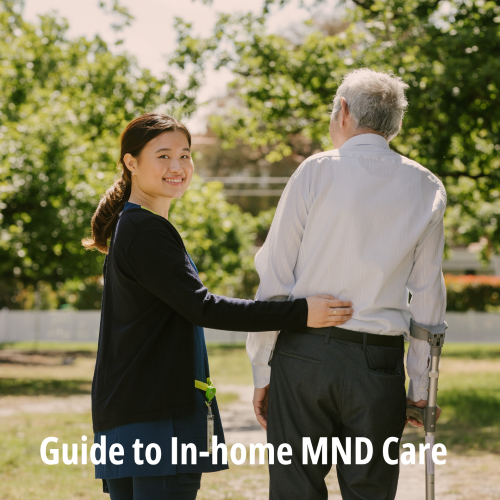
MND Care at Home
In-home care provides comfort and supports independence for people living with MND. In-home care can also serve as short term respite for primary caregivers.
People living with MND receive better care when the team caring for them use a coordinated, integrated approach. Multidisciplinary MND care is delivered by health professionals from a range of disciplines who work together to deliver seamless care, tailored to the individual’s needs.
Your multidisciplinary team may include your GP, nurses, neurologists, physiotherapists, occupational therapists, psychologists, social workers, in-home care workers and other health professionals.
At Prestige Inhome Care, their team works alongside GPs, hospitals, pharmacies, support coordinators, occupational therapists and other healthcare professionals to ensure seamless and safe MND care at home.
They adapt to the changing needs of MND clients, ensuring you receive the appropriate level of care at all times.
Prestige is both a registered NDIS provider and approved Support at Home provider, and they also offer private MND support services.
Prestige Inhome Care’s MND services include:
- In-home nursing
- Personal care
- Transport
- Respite care
- Meal preparation & Shopping
- Domestic assistance
- Companionship
- Overnight care
- Palliative care
- 24 Hour care and more.
Would you like to learn more?
For more information, please contact the friendly team at Prestige Inhome Care on 1300 10 30 10 or online: Contact Us – Prestige Inhome Care


